Why Training Slower Could Make You Faster: The Science of Zone 2 Training
Why easy training might be the missing piece in your performance, recovery and long-term health
If you've spent any time around runners, cyclists, triathletes or endurance athletes, you've probably heard someone talking about Zone 2 training.
Perhaps you've also heard things like:
"You need to slow down to get faster."
Or:
"Elite athletes spend most of their time training easy."
At first glance, this doesn't make much sense.
Surely training harder leads to better results?
Not necessarily.
In fact, one of the biggest mistakes many people make is spending too much time training at moderate to high intensities and not enough time building the aerobic foundation that supports everything else.
That's where Zone 2 comes in.
Often referred to as the "endurance zone", Zone 2 training forms the foundation of aerobic fitness and can improve everything from endurance performance and recovery to heart health and longevity.
But is it really worth the hype?
Let's explore.
What Are Heart Rate Zones?
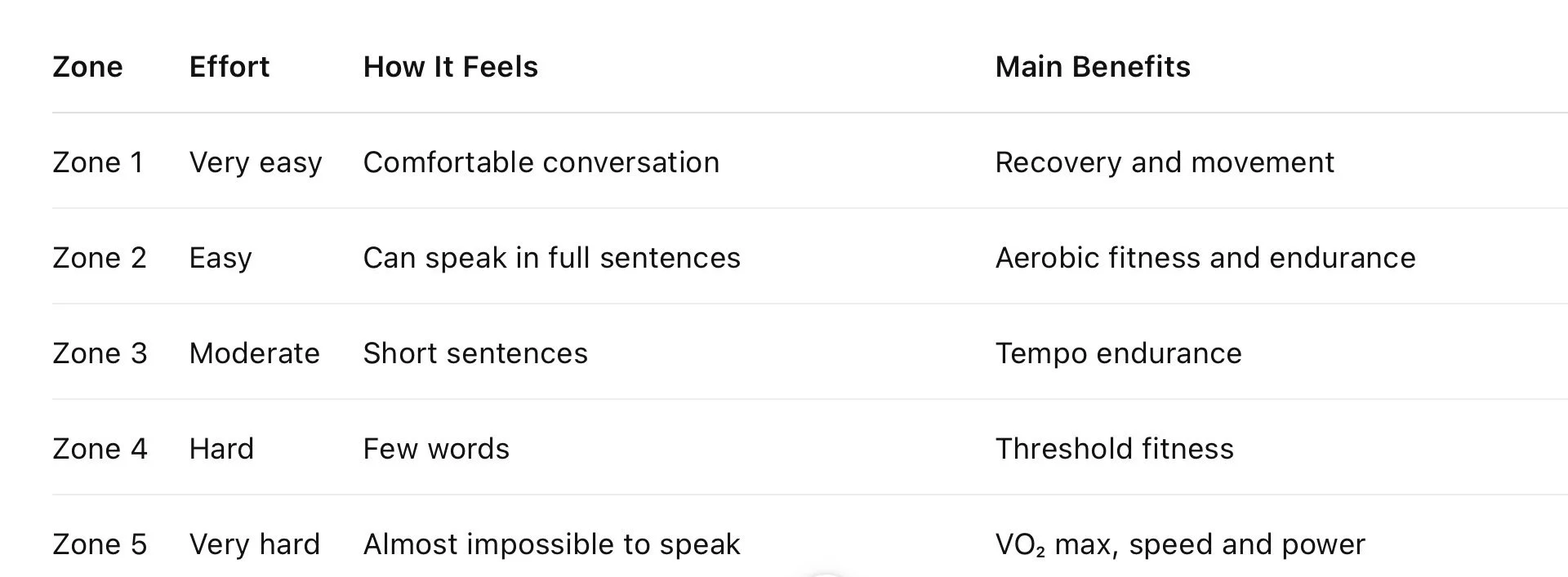
Exercise intensity is often divided into five heart rate zones.
Check out them out at the bottom of this blog
Each zone serves a purpose.
The goal isn't to avoid certain zones.
The goal is to understand when and why to use them.
What Exactly Is Zone 2?
Zone 2 typically occurs at around 60–70% of your maximum heart rate, although individual variations exist.
The easiest way to identify it is often the talk test:
✅ You can comfortably hold a conversation.
✅ You can speak in full sentences.
❌ You shouldn't be gasping for breath.
For many people, the surprising thing about Zone 2 is just how easy it feels.
In fact, if you're wondering whether you're working hard enough, you're probably doing it correctly.
This is why many people struggle with Zone 2 training.
It doesn't feel impressive.
It doesn't feel exhausting.
But that doesn't mean it isn't effective.
Why Do Elite Athletes Spend So Much Time Training Slowly?
Elite endurance athletes often spend around 70–80% of their training time at relatively low intensities.
This approach, sometimes referred to as polarised training, allows them to:
build a huge aerobic base
recover more effectively
tolerate higher training volumes
perform harder sessions at greater quality
reduce injury and burnout risk
The reality is that elite athletes don't become exceptional because every session is hard.
They become exceptional because they can consistently complete thousands of quality training sessions over many years.
Zone 2 helps make that possible.
Zone 2 Isn't Just for Endurance Athletes
Despite its reputation, Zone 2 training isn't only beneficial for runners, cyclists and triathletes.
It can also benefit:
Footballers
improved recovery between efforts
greater work capacity
better aerobic conditioning
Strength athletes
improved cardiovascular fitness
enhanced recovery
increased work tolerance
Hyrox and hybrid athletes
stronger aerobic foundation
improved recovery between stations
better pacing strategies
General population
improved heart health
metabolic health benefits
better long-term health outcomes
Older adults
improved cardiovascular function
maintenance of independence
support for healthy ageing
In many ways, Zone 2 isn't where you demonstrate fitness.
It's where you build it.
What Happens Inside Your Body During Zone 2 Training?
This is where things get interesting.
Every time you complete a Zone 2 session, your body asks:
"Should I become better at producing energy this way?"
If the answer is repeatedly "yes", your body begins to adapt.
These adaptations include:
More mitochondria
Mitochondria are often called the "powerhouses" of your cells.
More mitochondria means a greater ability to produce energy aerobically.
Increased capillary density
Your body develops more tiny blood vessels, improving oxygen delivery to muscles.
Improved stroke volume
Your heart becomes more efficient, pumping more blood with each beat.
Better fat utilisation
Your body becomes better at using fat as a fuel source during exercise.
Improved lactate clearance
You become more efficient at clearing and recycling lactate, allowing you to sustain higher intensities for longer.
Enhanced recovery
Your nervous system becomes better at switching between stress and recovery states.
The Benefits of Zone 2 Training
Improved endurance
Perhaps the most obvious benefit.
A larger aerobic base allows you to maintain effort for longer.
Better recovery
A stronger aerobic system helps you recover both between sessions and during exercise itself.
Improved cardiovascular health
Zone 2 training can support:
heart function
blood pressure
cholesterol management
circulation
Increased training capacity
The fitter your aerobic system becomes, the more work you can tolerate.
Metabolic health
Zone 2 training improves insulin sensitivity and overall metabolic efficiency.
Healthy ageing
Maintaining cardiovascular fitness is strongly associated with improved quality of life and longevity.
Are There Any Downsides?
Absolutely.
Zone 2 is not a magic solution.
It takes time
Building aerobic fitness happens over months and years, not days and weeks.
It can feel boring
Steady, easy exercise isn't always exciting.
It doesn't develop everything
Zone 2 won't optimally improve:
maximal strength
sprint speed
explosive power
VO₂ max
anaerobic performance
It's easy to do too hard
Many people accidentally turn Zone 2 into Zone 3.
This often creates more fatigue without necessarily maximising adaptation.
What About Zone 3?
Poor Zone 3.
It often gets unfairly criticised.
Zone 3 is moderate intensity exercise where conversation becomes more difficult.
This intensity can be extremely valuable for:
tempo running
Hyrox training
football conditioning
race pace preparation
sustained endurance efforts
The problem isn't Zone 3 itself.
The problem is doing everything in Zone 3.
If every session feels moderately hard, you're probably making some sessions harder than they need to be, and others easier than they should be.
Why Higher Intensity Still Matters
If Zone 2 builds the foundation, higher intensity training builds the upper floors.
Zone 4 training can improve:
lactate threshold
pace tolerance
sustained performance
Zone 5 training can improve:
VO₂ max
speed
power
sprint performance
A useful way to think about it is:
Zone 2 builds the engine.
Higher intensity teaches you how to use it.
The goal isn't to train as hard as possible.
The goal is to train as effectively as possible.
Does Zone 2 Burn More Fat?
This is one of the biggest myths surrounding Zone 2.
Yes, during Zone 2 exercise your body typically burns a greater proportion of fat relative to carbohydrates.
However, this does not automatically mean you will lose more body fat.
Body fat loss still depends primarily on overall energy balance over time.
Zone 2 can support fat loss because it is:
sustainable
low impact
easier to recover from
easier to perform consistently
But there is no magical fat-burning zone.
How Much Zone 2 Should You Do?
This depends on your goals.
General health
2–3 sessions per week
20–45 minutes
Recreational runners
2–4 sessions per week
30–90 minutes
Footballers
1–2 sessions per week alongside speed and sport-specific work
Strength athletes
1–2 sessions per week for cardiovascular health and recovery
Endurance athletes
often 60–80% of total training volume
🔬 The Science Behind Zone 2
Research suggests that low-intensity aerobic training can lead to:
increased mitochondrial biogenesis
improved stroke volume
greater capillary density
improved fat oxidation
enhanced lactate metabolism
increased aerobic efficiency
improved autonomic nervous system function
These adaptations don't happen because one session was particularly hard.
They happen because the same stimulus is repeated consistently over time.
This is why many coaches describe aerobic fitness as the foundation of athletic performance.
Because without a strong foundation, everything built on top becomes harder.
The Coached FITT Takeaway 🧡
Zone 2 training isn't glamorous.
It probably won't leave you exhausted.
It won't give you the same feeling as an all-out interval session.
But that doesn't mean it isn't important.
In fact, it may be one of the most valuable forms of training you can do.
Because the goal isn't to train as hard as possible.
It's to train as effectively as possible.
High-intensity training raises your ceiling.
Zone 2 raises the floor that supports everything else.
And sometimes, getting better means learning to slow down. 💪🧡