🚨 Creatine Has an Image Problem
Creatine is one of the most misunderstood supplements in fitness.
Some people think it’s:
Only for bodybuilders
Bad for your kidneys
Going to make you “bulky” or bloated
👉 None of that is true.
In reality, creatine is:
One of the safest supplements available
Extremely well-researched
Useful for performance, health, and longevity
At Coached FITT, we focus on the basics first — training, nutrition, recovery.
Creatine doesn’t replace those.
It simply helps you get more out of them.
🧠 What Is Creatine?
Creatine is a naturally occurring compound made from amino acids.
Around 95% is stored in skeletal muscle
It helps regenerate ATP — your body’s fast energy source
ATP fuels lifting, sprinting, jumping, and hard intervals
You get small amounts from red meat and fish.
Your body produces some naturally.
But diet alone rarely fully saturates muscle creatine stores — especially if you train regularly.
That’s where supplementation comes in.
💪 What Are the Benefits of Creatine?
⚡ 1. Increased Strength & Power
Creatine consistently improves:
Max strength
Repeated effort performance
Sprint and explosive power
Why?
It allows faster ATP regeneration, meaning you can:
Lift heavier
Perform more reps
Maintain power across sets
Better sessions = better long-term results.
🏋️ 2. Improved Muscle Growth & Lean Mass
Creatine supports muscle growth by:
Increasing total training volume
Improving recovery between sets
Increasing water inside muscle cells (cell volumisation)
This isn’t “fake size.”
The increase in intracellular water supports performance and creates an environment that supports real muscle growth over time.
🏃♂️ 3. Better Performance for Hybrid & Event Athletes
Creatine isn’t just for lifters.
It’s especially useful for:
Hybrid athletes (Hyrox, CrossFit, football)
Endurance athletes who also lift
Team sports and combat sports
Benefits include:
Improved repeat sprint ability
Better power late in sessions
Strength retention during high-volume blocks
Perfect for the Coached FITT hybrid crowd.
🧠 4. Cognitive & Mental Performance
Creatine also supports ATP production in the brain.
Research suggests it may support:
Reaction time
Resistance to mental fatigue
Short-term memory
Cognitive performance under stress or poor sleep
It does not replace sleep.
But it may help maintain mental performance when energy demand is high.
This makes creatine useful not just for athletes, but also:
Busy professionals
Parents
Shift workers
Anyone under high cognitive load
🧬 5. Long-Term Health & Ageing
Creatine isn’t just about aesthetics or gym numbers.
It may help:
Preserve lean mass as we age
Improve functional strength
Support bone density (indirectly, via strength training)
Support glucose metabolism
This is why creatine is increasingly viewed as a healthspan supplement, not just a performance one.
🥄 Creatine Dosage: Is 5g Enough?
✅ The Standard Recommendation
For most people:
3–5g of creatine monohydrate per day
No loading phase required
Timing isn’t critical
Consistency matters most
Creatine works by saturating muscle over time.
It’s not about what happens in one session.
It’s about maintaining full stores long term.
That’s why you take it:
✔ Every day
✔ Not just on training days
Staying well hydrated is recommended, as creatine increases intracellular water storage.
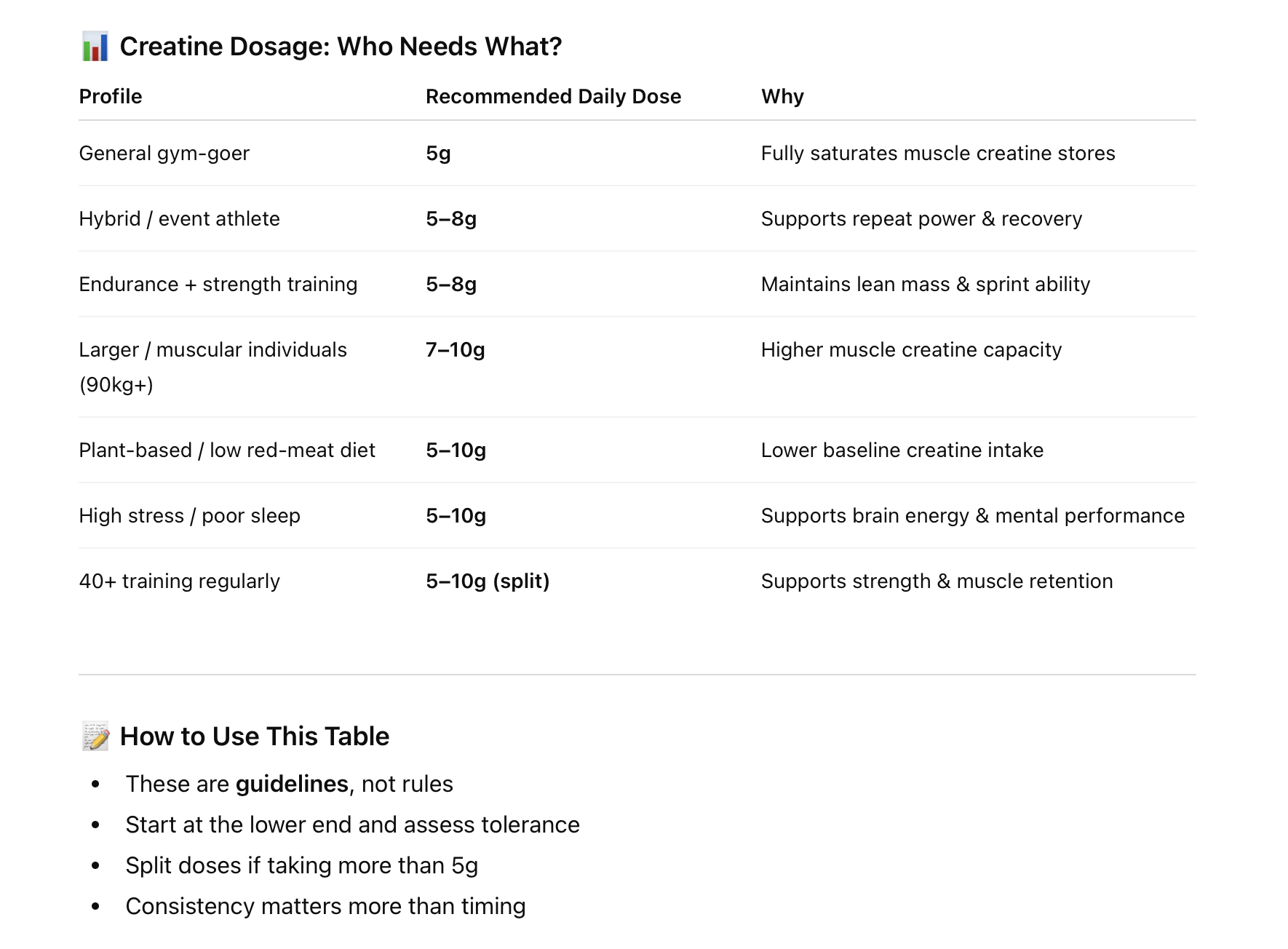
📈 When Might More Than 5g Make Sense?
While 5g works for most people, slightly higher doses may be useful if you:
Carry higher lean body mass
Train at high volume or frequency
Combine strength and endurance work
Follow a plant-based or low red-meat diet
Are 40+ and lifting consistently
Are under high physical or cognitive stress
In these cases:
➡ 5–8g per day is often sufficient
➡ Up to 10g per day has been studied safely in healthy adults
More isn’t automatically better.
Appropriate is better.
⏳ Do You Need a Loading Phase?
A traditional loading protocol:
20g per day (split into 4 doses) for 5–7 days.
This saturates muscles faster.
But it is not necessary.
Taking 3–5g daily will fully saturate stores within 3–4 weeks — without digestive discomfort.
For most people: skip the loading phase.
⏰ Does Timing Matter?
Short answer: not much.
Some research suggests taking creatine near training may offer a small advantage due to increased blood flow and uptake.
But the difference is minor.
The priority is:
✔ Daily intake
✔ Long-term consistency
✔ Taking it in a way you’ll stick to
With food may slightly help absorption — but again, consistency wins.
❌ Common Myths (Quickly Debunked)
“Creatine causes bloating”
Creatine pulls water into muscle cells — not under the skin.
That intracellular water supports performance.
It doesn’t make you soft.
“Creatine damages kidneys”
There is no evidence of kidney damage in healthy individuals, even with long-term use.
Creatine is one of the most studied supplements in sports nutrition, with decades of safety data in healthy adults.
Creatine can slightly increase creatinine levels in blood tests — but this reflects normal metabolism, not kidney dysfunction.
Anyone with existing kidney disease should consult a medical professional before supplementing.
“Creatine is only for men”
False.
Women often have lower baseline creatine stores and benefit significantly — especially for strength, performance, and muscle retention.
Creatine alone does not cause unwanted mass gain.
🏆 What Type Should You Use?
Creatine monohydrate.
It is:
The most researched
The most effective
The most affordable
Other forms (HCL, buffered, blends) have not consistently outperformed monohydrate.
You don’t need the expensive version.
🔑 The Bottom Line
For most people:
✔ 5g per day
✔ Take it daily
✔ Use monohydrate
✔ No loading needed
Creatine helps you:
Train harder
Recover better
Maintain lean mass
Support cognitive performance
Age stronger
It’s not a shortcut.
It simply helps you get more from the work you’re already doing.
And that’s exactly what we’re about at Coached FITT.